Here is the strange thing about the way we talk about business. Someone walks into a room, writes “Revenue minus Cost equals Profit” on a whiteboard, and everyone behaves as if a great truth has just been revealed. Nobody objects. Nobody asks whether the formula is missing anything important. Nobody points out that the most valuable parts of a business usually refuse to sit nicely inside that equation.
Because the real value of a business is rarely found only in its revenue and costs. It is also found in trust, reputation, habit, status, timing, distribution, defensibility, and the small irrational preferences that make a customer choose one brand over another almost identical one. The basic formula is not wrong. It is simply too small. It describes the accounting of a business, not the life of a business.
What I want to propose is a better way to think about business value. Not a perfect formula. Not a magic calculator. A more honest mental model. One that accepts that businesses are not just machines for producing profit. They are living systems made of people, incentives, emotions, frictions, stories, and risks.
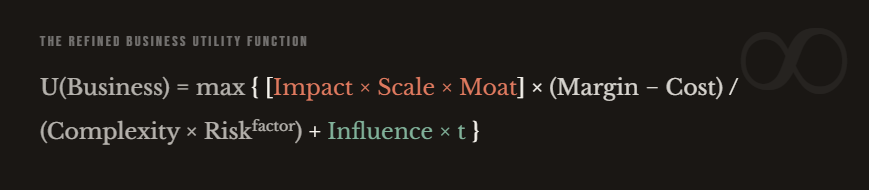
I know that using a formula may seem like surrendering to the very neat, spreadsheet-minded thinking I am arguing against. But that is exactly why it works. The formula is not meant to explain everything. It is meant to disturb the usual explanation and quietly introduce the things business theory often prefers not to say out loud.
The Tyranny of the Obvious
The standard idea of a good business usually goes like this: find something people want, sell it for more than it costs to produce, and repeat the process at scale. This is the kind of thinking that creates businesses designed to look understandable. Businesses that look impressive in a PowerPoint deck, make sense to a bank, and satisfy the neat little story expected by someone holding an MBA and a laser pointer.
“The most valuable thing a business can possess is not a cost advantage. It is the ability to make its price irrelevant to operate in a psychological space where comparison is difficult, uncomfortable, or simply doesn’t occur to the customer.”
– Hailemichael Adugna
What this view consistently undervalues is the part of business that refuses to fit neatly into a spreadsheet. The feeling a customer gets when they walk through a door. The sense of trust attached to a reputation. The strange but powerful impression that a brand somehow understands them better than the cheaper alternative ever could.
These things are often treated as soft or secondary, when in reality they are frequently the entire reason a business succeeds. Apple does not command a premium simply because its laptops are made from better aluminium. People pay for the feeling attached to owning one. The product quietly signals taste, creativity, design awareness, and membership in a certain kind of tribe. The emotional meaning becomes inseparable from the object itself.
That is not marketing fluff sitting on top of the product. In many cases, it is the product. And conventional business thinking still struggles to account for it.
Why Multiplication Matters More Than You Think
The most important part of the formula is the multiplication between impact, scale, and moat. That multiplication sign is doing far more work than people realize. It quietly explains why so many businesses that look brilliant in isolation still collapse in practice. Because multiplication is unforgiving.
When factors multiply together, a weakness in one area does not politely reduce the outcome a little. It can destroy the outcome entirely. One zero wipes out everything beside it.
company may build a product that genuinely changes people’s lives. Customers may love it. Reviews may be extraordinary. The founder may even believe they have discovered something revolutionary. But if the business has no defensibility, no distribution advantage, no brand loyalty, no network effect, and no operational edge, then the market treats the innovation like an open buffet.
Larger competitors arrive with more capital, stronger logistics, better hiring power, and existing customer trust. They copy the useful parts, remove the fragility, and scale it faster than the original creator ever could.
The cruel part is that the original founder is often not wrong about the product. They are simply incomplete in their understanding of business survival.
Scale without impact is not power. It is expensive noise. You can reach a million people with a message nobody cares about and still have nothing worth defending. You can buy attention, but you cannot buy meaning. And if the thing being scaled does not matter, scale only helps you waste money faster.
This is why business is rarely a fair contest of product quality alone. The market does not simply reward the best idea. It rewards the idea that is useful, scalable, and hard to attack. A founder who only focuses on making something useful is behaving like an inventor. A founder who understands multiplication begins thinking like a strategist.
The Interesting Thing About Risk
Most people think about risk in the wrong way. They treat it as something you simply subtract from the upside, as though uncertainty behaves like a predictable expense sitting quietly at the edge of the spreadsheet but risk does not behave politely.
Risk changes the entire structure of a business. It spreads outward. It reshapes decisions long before the catastrophe itself ever arrives.
A business with a serious chance of collapse does not merely become slightly less valuable. Everything around it begins to weaken.
– Investors demand disproportionate rewards for participating.
– Talented employees hesitate to commit their careers to it.
– Suppliers tighten payment terms.
– Customers drift toward competitors that feel safer and more permanent.
“Risk is not a fee you pay. It is gravity you operate under.”
That is why the formula places risk in the denominator instead of subtracting it from the outcome. As risk increases, the entire value of the business becomes compressed. Not gradually, but often violently.
A stable business remains structurally intact. A moderately risky business sees its potential heavily reduced. A business facing existential danger gets crushed regardless of how impressive the opportunity may have looked on paper.
Moat: The Part People Respect Too Late
The earlier version of this formula used speed as one of the multipliers. Speed matters. Speed gives you a window. It lets you move before competitors understand what is happening. But speed is temporary. Eventually, someone notices. Someone copies. Someone catches up. What you really want is for that window to become a wall!
A moat is anything that makes competing with you structurally unpleasant. It may be a network effect, where each new user makes the product more valuable for everyone else. It may be a brand that people trust without needing to compare alternatives. It may be distribution that others cannot easily access. It may be a habit so deeply embedded in the customer’s life that switching feels like unnecessary effort.
The best moats do not always look dramatic from the outside. Sometimes they are boring. Sometimes they are hidden inside operations, relationships, culture, or accumulated trust. But they all do the same thing: they make competition harder than it looks.
That is why first-mover advantage is so often overrated. Being first is only useful if being first helps you become harder to replace. Otherwise, you are simply doing free market research for the company that arrives second with more money.
Influence and Time
The most underrated part of the formula is influence multiplied by time. It sits outside the main calculation because influence works differently from the other variables. It does not behave like a normal operating metric. It compounds quietly. It survives bad quarters. It carries memory. It gives a business permission to be chosen before it has fully explained itself.
A brand built over thirty years is not just a logo. It is stored belief. It is thousands or millions of tiny positive associations stacked on top of each other until the customer no longer feels like they are making a decision at all.
This is why some businesses can survive mistakes that would kill a weaker company. Influence gives them a cushion. It gives them time. It gives them the benefit of the doubt. And in business, the benefit of the doubt is one of the most profitable assets in existence.
Time makes influence unfair. A new competitor can copy your product features. It can copy your website. It can copy your pricing. But it cannot instantly copy twenty years of trust, familiarity, cultural presence, and repeated proof.
That is why many companies destroy their own value when they sacrifice long-term influence for short-term performance. They think they are improving the numbers. In reality, they are selling the invisible asset that made the numbers possible.
The Hidden Tax
Complexity belongs in the denominator because complexity rarely adds only one problem. It creates problems in every direction at once.
Every new product line, new market, new department, new approval process, and new “strategic initiative” adds weight.
– It slows decisions.
– It creates meetings.
– It makes responsibility harder to locate.
– It gives talented people more reasons to wait for permission instead of acting with judgment.
The dangerous thing about complexity is that it often feels like progress. A business adds more services and feels bigger. It opens more channels and feels more serious. It creates more reporting systems and feels more professional. But sometimes the company is not becoming stronger. It is simply becoming harder to move.
“The correct response to ‘we should also do this’ is usually: what are we going to stop doing to make room for it?”
The silence after that question is usually very educational. Great businesses often look simpler than mediocre businesses because they have learned to say no. They protect focus. They remove unnecessary decisions. They avoid the temptation to confuse activity with advantage.
Complexity is not always bad. Some complexity is the price of growth. But complexity must earn its place. If it does not increase the numerator more than it increases the denominator, it is not strategy. It is drag wearing a suit.
The Part Everyone Ignores
The formula begins with “max,” and that may be the most important part. It means the goal is not simply to describe the business you currently have. The goal is to ask what the best possible version of the business could become.
Most companies do not really optimize. They continue. They improve the existing product a little. They add a nearby service. They hire a few more people. They move forward from where they already are, because the current version of the business feels like reality. But the max operator asks a more uncomfortable question: if we looked at our assets, customers, capabilities, trust, distribution, and market position with fresh eyes, what business should this actually be?
Sometimes the honest answer is not the current business. That is uncomfortable because it forces a founder to admit that the thing they started may only be the doorway, not the destination.
– The first product may be the training ground.
– The first market may be the proof.
– The first business model may be a rehearsal for the better one hiding underneath.
Amazon did not remain only an online bookstore. The deeper asset was not the books. It was infrastructure, logistics, customer trust, and eventually cloud capability. The original business created the conditions for a much larger business to reveal itself.
That is what the max operator is trying to remind us. Strategy is not only about making the current machine more efficient. Sometimes it is about realizing you have been building the wrong machine around the right asset.
So What Should You Actually Do With This?
This formula is not a spreadsheet. It will not give you a clean number. It will not tell you with scientific certainty whether your business will win. Anyone who claims to measure every part of this with precision is either overconfident or selling consulting hours.
The formula is better used as a set of uncomfortable questions.
Is the impact real, or is it only impressive in the founder’s imagination? Can the business scale without breaking itself? Is the moat genuine, or is it just “we are first” said with confidence? Are margins strong enough to survive reality? Is cost under control, or merely hidden for now? Is complexity quietly eating the company? Is risk being managed, or politely ignored? Is influence being built over time, or sacrificed for short-term sales?
Ask of any business decision: does this increase the numerator more than it increases the denominator? Most decisions that sound strategic increase both. The best decisions increase value while keeping complexity and risk under control.
So the real advantage goes to the business owner who can respect both sides. The numbers matter. Of course they do. But the numbers are not the whole business. They are the shadow the business casts after trust, desire, risk, defensibility, and execution have already done their work.
The formula is useful only because it reminds us of something simple and easy to forget: business value is not created by one clean variable. It is created by the interaction of many forces, some visible, some invisible, some rational, and some beautifully irrational.
